
Guest article by Sam Glassenberg, a video game developer who has created games for major Hollywood films like Star Wars, the Hunger Games, and Mission Impossible.
Worst. Game. Ever.
In December 2019, our 5-year-old daughter, J, was diagnosed with type 1 diabetes (T1D). The onboarding experience was absolutely brutal.
When making games, there are all sorts of rules and design principles to make them easy to learn, fun, and highly rewarding—that’s why the video games industry is now bigger than Hollywood and the music industries combined.
As a game developer, it was shocking to see how the onboarding and ongoing management of type 1 diabetes literally turned every video game design best practice on its head. To experience type 1 diabetes is to experience something that takes all of the best practices involved in creating a wonderful, engaging, rewarding game, and inverts them to create the most frustrating and punishing experience possible for the patient and caregiver alike.
I’m a computer engineer. My wife is a primary-care pediatrician. On paper, we’re the T1D management dream team. It didn’t matter. We read all the books, and it still took us a year of gut-wrenching trial-and-error on our own child to finally understand how this all works: carb ratios, insulin sensitivity factor (ISF), pre-bolusing, digestion rates, and insulin stacking.
Learning through play
Humans (all mammals, actually) learn best through play. That’s why video games are so effective at helping humans develop mental models of complex systems – from predicting parabolic flight (Angry Birds) to understanding how cities work (Sim City).
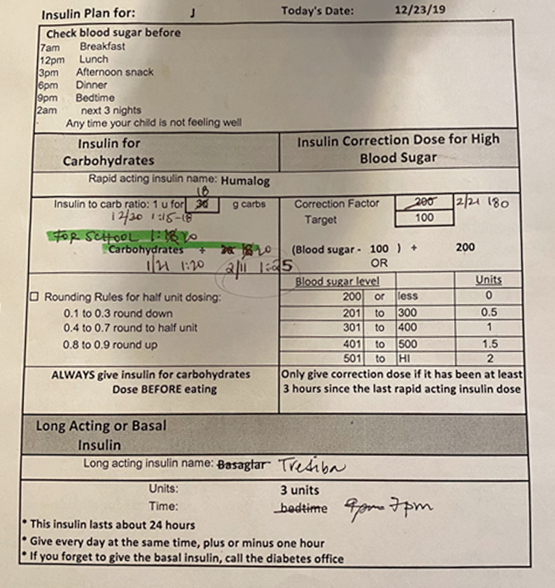
I still remember the one-page guide we received after those two first days in the hospital: a page of hand-scribbled carb ratios, insulin sensitivity factors, and instructions from the endocrine department that made little sense.
How it should be
Imagine it’s day #2 in the hospital. Mom and Dad are beside themselves as the magnitude of their new responsibilities as a full-time pancreas becomes brutally clear. The diabetes educator walks in.
“Here, download this game. Play it for two hours. It’ll explain all of this. Come to me afterward with any questions”.
I would have played the crap out of that game had it existed.
Joining the team
Shortly after J’s diagnosis, I joined the Breakthrough T1D Play advisory council (JDRF Game2Give at the time). It turns out that there’s a whole team of veteran game developers and executives like me who have T1D or care for someone who does. Play does amazing work, from creating a virtual world experience on Roblox to fundraising for Breakthrough T1D on Steam, Twitch, Humble Bundle, and other game platforms.
Everyone was on board with the idea of using games not only to fundraise for type 1 diabetes, but to improve the T1D onboarding process for the newly diagnosed.
Choosing the right mechanic
About a year into the process, I had developed a solid ‘mental model’ about what was going on inside my daughter’s endocrine system. How could I share that mental model? What video game mechanics are best for helping someone understand T1D?
A few popular reference games came to mind:
- Rhythm games like Guitar Hero and Rock Band are great at training your brain how to time your actions with a simple interface – like timing insulin dosing.
- Games like Missile Defense encourage you to shift your thinking from where the target is to where the target is going – just like with glucose curves.
- Particle Puzzles like Frost and Where’s My Water use swarms of particles to captivate and inspire the player
So, I got to work writing up a Game Design Document (GDD).
A Level Ex game jam
As it happens, my current company, Level Ex, makes video games for doctors. Roughly once a year, we host a “game jam,” where we break out into teams, and each team has ~48 hours to produce a fully functional game prototype for a new idea. We used this game jam to prototype the game I’d designed and prove that particle mechanics really could capture the nuances of insulin and glucose dynamics (spoiler alert: it worked better than anyone expected).
Making the game: Level One
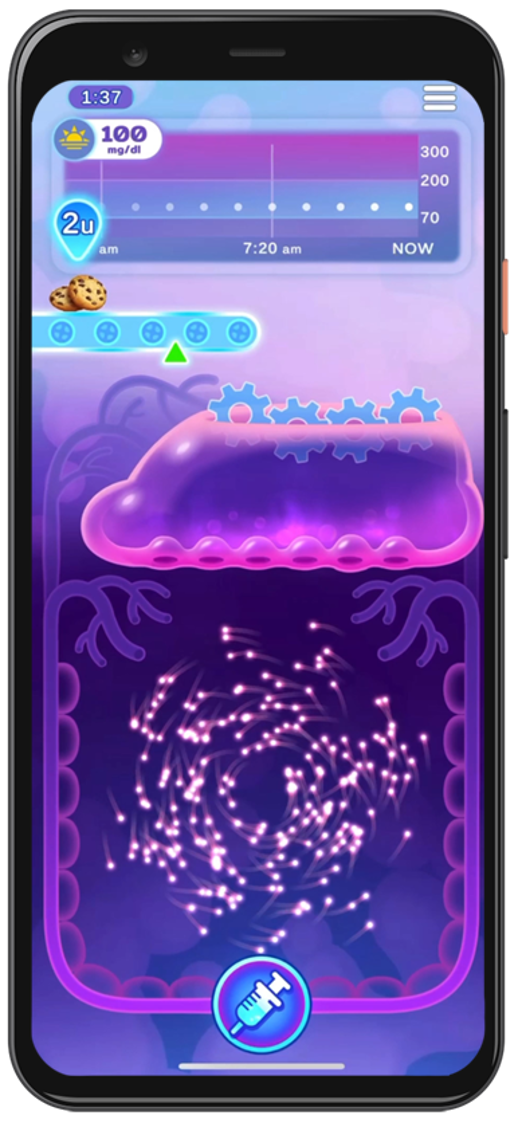
Once the prototype was working, we got to work on making the full game, honing the visual style, particle dynamics, and level design. Throughout the process, we play-tested it with endocrinologists, diabetes educators, parents, and camp counselors.
The results were overwhelming. Testers LOVED the game. Several times, we had to cut people off from the Testflight beta build because they were sharing the game with their patients when they weren’t supposed to.
Now available
After years in development, Level One is now available to download. We look forward to continuing to add features and improve the game as we go. Most importantly, the game is free to everyone (thanks to partners like Breakthrough T1D Play). We’re improving diabetes onboarding with a game that is actually fun to play, so no other parent has to go through this experience again.
Download Level One now:


Breakthrough T1D Game2Give is a program that brings together the type 1 diabetes (T1D) community and the video game community. When Insulet, the makers of Omnipod®, asked us to team up on bringing diabetes representation to Animal Crossing™, we couldn’t say no!
Animal Crossing™: New Horizons is a popular Nintendo Switch™ game that puts you in charge of your own personal island. Insulet used the tools available to Animal Crossing™ players to create Omnipod Bay, an island that reflects the experiences of people with diabetes. Breakthrough T1D and three other T1D advocacy groups—Beyond Type 1, Children with Diabetes, and Kyler Cares Foundation—have a presence on the island.
If you or your kids already play Animal Crossing™, you know it’s a charming family-friendly game that’s easy to get lost in. The same is true of Omnipod Bay! To get there, lie in bed and enter the dream code DA-9645-5879-6910.
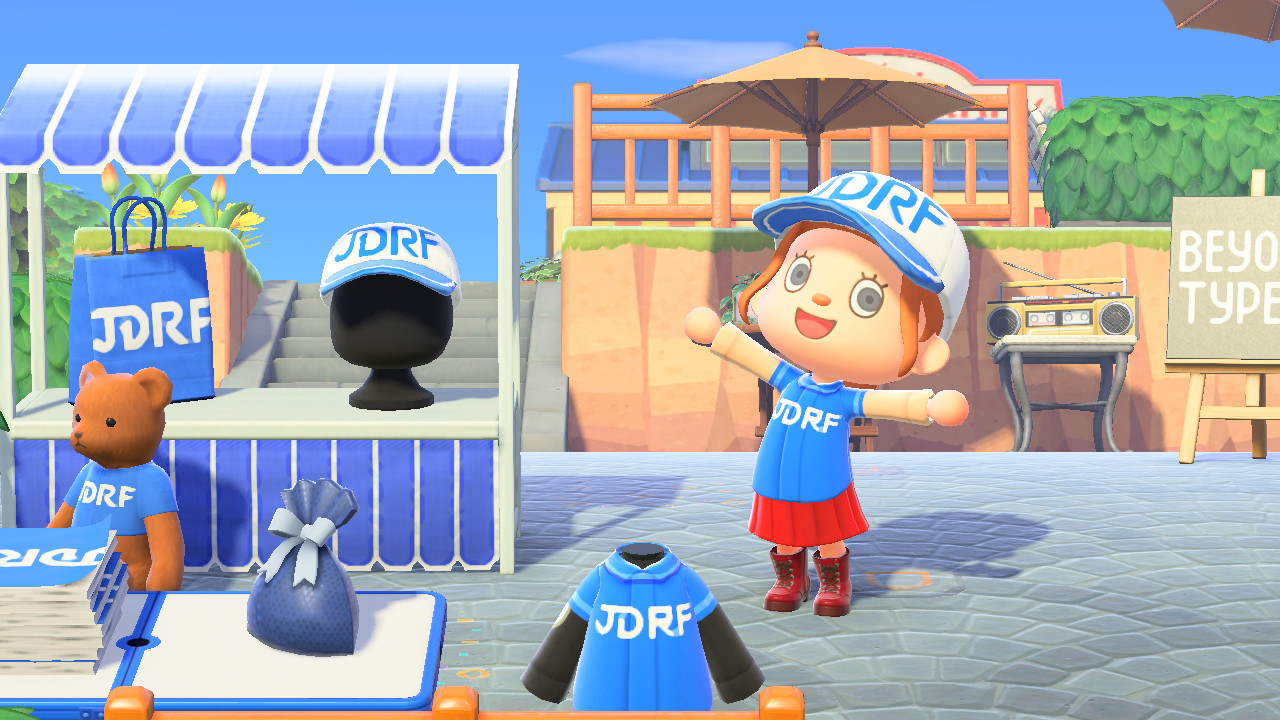
On the island, you can solve an obstacle maze, sing in a concert, explore themed areas (like diabetes camp, Bolus Beach, and the A1 Sea), walk the runway, and even piece together a hidden code to win an in-game prize. Make sure to check the bulletin board near the arrival spot for clues about what to do.
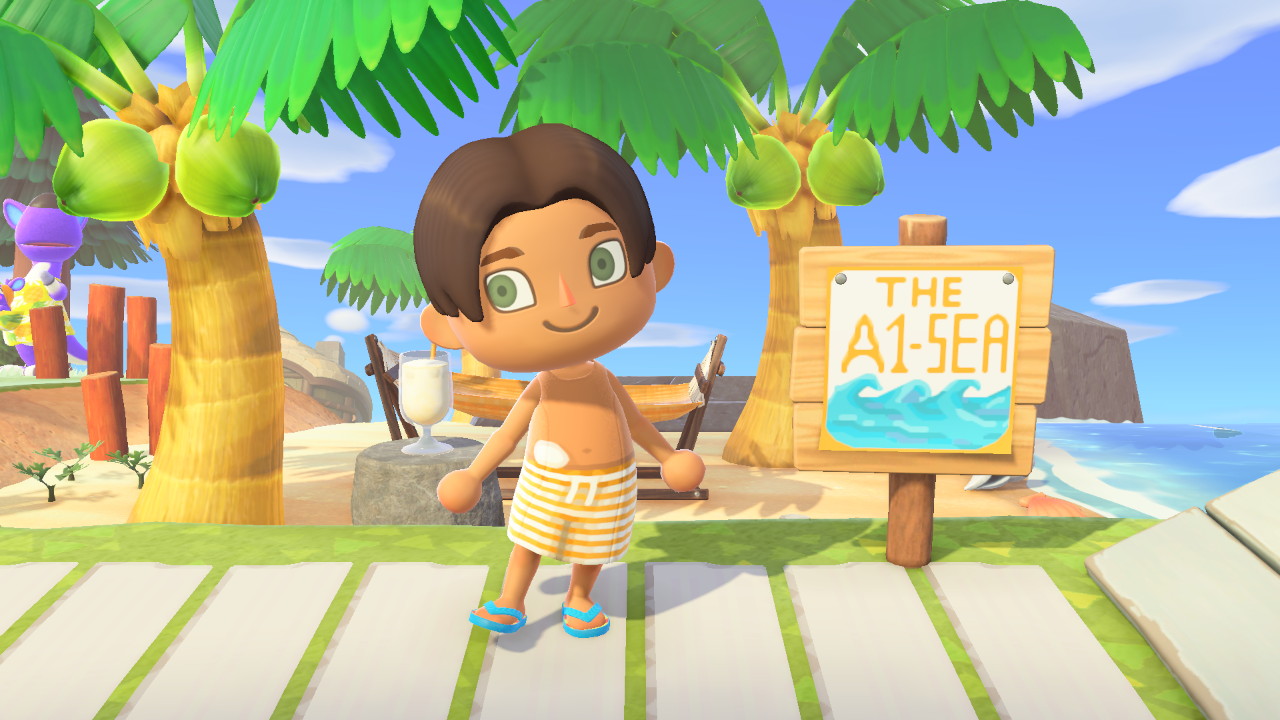
One of the coolest things on Omnipod Bay is the clothes. Fifteen outfits are available with pumps and diabetes supply bags built in, as well as varied skin tones, so you can customize your character to look more like you. There are also shirts and caps from each of the four advocacy groups. These are all free to download, and you can wear them back on your own island too. Make sure to snap some selfies!
Community members Patch Notes, Nukkular_Reaction, RogueLiliana, Resurrection Fern, and VirtuallyMarti celebrated the Omnipod Bay launch with a charity livestream event on Twitch.
Want to do your own Animal Crossing™ charity stream and help us raise $15K for T1D research? Register a campaign on Tiltify and go for it! Use the hashtags #OmnipodBay and #GameOverT1D on social media to help us find your stream.
We in the diabetes community know how incredibly important it is to see people with T1D represented in pop culture. Omnipod Bay is a huge step forward, helping to normalize diabetes in a video game that has sold more than 37 million copies. We’re proud that Insulet asked Breakthrough T1D to partner on this project and we’re excited for all the Animal Crossing™ fans in our community to experience it.
You can learn more about the island and view all of the diabetes-ready fashion outfits from Insulet’s Omnipod Bay website.
