

Aaron Prager was diagnosed with type 1 diabetes (T1D) when he was just 17 months old, so he doesn’t remember life without it. What he does remember is how much work it took for his family to keep him safe in the early years, before any of his diabetes tools connected to each other. Every number was written down, and every decision was a calculation.
Aaron grew up surrounded by code. Both of his parents are software engineers, and he spent his childhood at coding camps building video games. In sixth grade, he made an insulin calculator for his science fair. That project sparked a question that has driven him ever since: why couldn’t technology do more to help people with T1D understand what was happening with their blood sugar?
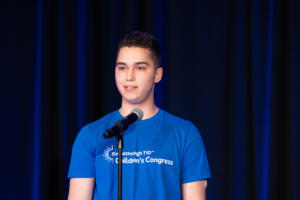 In 2025, Aaron traveled to Washington, D.C., as a Massachusetts delegate to Breakthrough T1D Children’s Congress, where he shared his story with members of Congress and urged them to keep funding T1D research. He met kids from across the country, including some who didn’t have access to an endocrinologist. “My experiences with Breakthrough T1D, especially Youth Advocacy and Children’s Congress, played a big role in motivating me to work on projects that support the T1D community,” Aaron said.
That motivation became BoostT1D. The app connects with Nightscout to find patterns and trends in glucose, insulin, and carb data, and it includes an AI feature that analyzes a photo of a meal, estimates the carbohydrates, and helps guide bolus calculations. Aaron designed it as a decision-support tool to make day-to-day diabetes management feel a little less overwhelming, with insights people can bring to their care team. He also built it for families without connected devices. Remembering the days when his family had no connected tools, he made sure BoostT1D also works with manually entered data and gives the same insights.
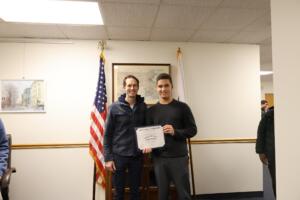 This year, BoostT1D was named the Congressional App Challenge winner for U.S. Rep. Jake Auchincloss’s district, and it won the grand prize in MIT Solve’s “AI for a Better World” student contest. For Aaron, though, the most meaningful part of the project is the volunteer and peer-support section of the website. Families can request a conversation for their child with a teen who understands what it’s like to balance diabetes, school, sports, and daily life. “I really enjoy connecting with younger kids living with T1D,” Aaron said. “Supporting younger kids and helping them feel less alone is something I care deeply about.” Peer support is nothing new for him. He also helps manage a Facebook support group of more than 8,000 Russian-speaking parents of children with T1D.
When he isn’t coding, Aaron can usually be found on the ballroom dance floor. He competes and hopes to represent the U.S. at the world championships someday. He proudly wears his CGM and insulin pump where everyone can see them.
After high school, Aaron plans to study math and computer science, and he hopes to help develop an artificial pancreas. Until there are cures, he’s building tools and connections that make life with T1D better today. Congratulations, Aaron. We’re proud to call you our November Cure Champion!
Learn more about BoostT1D at boostt1d.com.