

For 36 years, Matthieu Grigoresco has lived with type 1 diabetes (T1D). Over those decades, he has built a successful career, competed as an endurance athlete, and raised a family, proving that a T1D diagnosis does not have to stand in the way of ambition or achievement. But last year, his relationship with T1D changed in a profound way when his 15-year-old son was diagnosed with T1D.
Having spent most of his life managing T1D himself, Matthieu expected that experience would prepare him for the journey ahead. Instead, he discovered that supporting someone else through a diagnosis brings an entirely different perspective.
“The experience and support are very different when being in the driver’s seat or being the benevolent supporter,” he shared.
As a parent, Matthieu quickly learned that what worked for him would not necessarily work for his son. The experience challenged him to adapt, listen, and grow.
“Handling T1D is 90% self-drive and motivation based,” he said. “It made me grow as a coach.”
One moment, in particular, captures the reality of life with T1D for Matthieu. After confirming his son’s diagnosis and bringing him to the emergency room, they sat together discussing what would come next. Injections, monitoring blood sugar, and learning a new way of life would soon become daily routines. His son’s response remains etched in his memory.
“There is no alternative. If I do not handle it, I die. I just have to do it.“
For Matthieu, that moment reflected an important truth about T1D. There is often a clear “before” and “after” a diagnosis. While the condition presents daily challenges and frustrations, individuals living with T1D make a conscious choice every day to accept the reality before them and keep moving forward.
That resilience is something he wishes more people understood. Too often, he says, the struggles of T1D go unnoticed because those living with the condition continue to perform well at work, at school, and in their communities.
“Recognize the silent struggle,” he says. “People can achieve their ambitions, but sometimes people think this is nothing when they see a person with T1D performing well.”
He also encounters a common misconception: many people confuse type 1 diabetes with type 2 diabetes, overlooking the unique challenges faced by people living with T1D.
When it comes to advocacy and fundraising, Matthieu has found a powerful way to tell his story. As a competitive runner for more than a decade, participating in the NYC Marathon became a natural opportunity to support Breakthrough T1D while raising awareness. He previously ran the marathon in 2023 and plans to take on the challenge again.
For Matthieu, running serves two purposes. It helps fund the research that has transformed diabetes care over the years, and it demonstrates that T1D does not prevent people from pursuing ambitious goals.
“The fundraising is also an opportunity to talk about this silent condition around me,” he explains. “People do not necessarily know about my condition and understand that you can achieve in sports and at work despite the extra challenge.”
His commitment to the cause is rooted in gratitude. Having witnessed the dramatic advances in diabetes technology since the early 1990s, Matthieu knows that progress is made possible through research,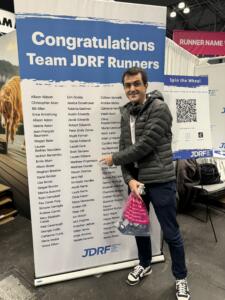 innovation, and sustained financial support.
Outside of his volunteer work, Matthieu leads the Risk Technology department in the Americas for a large Japanese bank. He credits many of his successes not to living despite T1D, but in some ways because of it.
“T1D has not been a drag. If anything, it made me more competitive and developed that urge to prove that I could achieve just like others.”
When asked what he wants others living with T1D to know, his answer is simple: anything is possible. There will be difficult days and added obstacles, but those challenges make every accomplishment that much more meaningful.
Looking to the future, Matthieu hopes for a cure, but he also advocates for something that can be achieved today: ensuring that people around the world have access to insulin and treatment regardless of where they live or their insurance coverage. Until then, he plans to keep sharing his story, supporting his son, and showing others what is possible when determination meets purpose.