

Vale Long was diagnosed with type 1 diabetes (T1D) in December 2025, when she was 9 years old. The Wilmington, North Carolina fourth grader says managing her T1D is all about planning ahead.
“Every time before I leave the house, I always make sure my pump’s good, I have my glucagon, I have some sugar snacks, and I have my phone,” Vale said.
Chelsea Long, Vale’s mom, agrees—and planning ahead is especially important during back to school season.
“With this upcoming school year, I think we’ve learned a couple things from the half a year that she’s gone so far, and a lot of it just comes down to the preparation and doing things ahead of time,” Chelsea said.
But she also says that planning and preparation went a lot easier thanks to the Wilmington community of fellow T1D moms and families.
“They have been just an essential and integral part of our diagnosis and our path, honestly,” Chelsea said. “A lot of the moms shared their 504 Plans, even down to the wording and the verbiage that they used, and little tips and tricks.”
Whether your child is starting a new school year or returning to school after a new diagnosis, managing T1D in the classroom can be a little intimidating. Breakthrough T1D is here with support and resources to help you and your child succeed, from preschool through college!
504 Tips and Tricks
Children with T1D should have 504 Plans, which are legal, written documents specifying what “reasonable” modifications and accommodations the school must provide for a student with a disability.
“For instance, when a child goes to a school function, there should still be someone there monitoring them at all times. That includes school dances or fundraisers that are still on school property, but maybe not during school hours, per se,” Chelsea said.
“Another example was a field trip—making sure that the teacher either goes along on that field trip, or there is someone who is comfortable on the bus in case there was an emergency,” she added.
A T1D Shopping List

Back to school means stocking up on notebooks, pencils, and perhaps a new backpack, but children with T1D like Vale need a few additional supplies, like snacks for when she goes low.
“I normally get applesauce and gummies and juice and peaches,” Vale said.
Chelsea says they like to get a variety of snacks, so Vale doesn’t get tired of having the same thing over and over, as well as a small bag to carry her phone or pump receiver in.
“Those are pretty fun, because you can personalize these or pick something with a pattern if you want,” Chelsea said.
Vale also likes to personalize her Dexcom sensor and Tandem Mobi pump with overpatches.
“They have all different ones, you know, so even like for the 4th of July, she found some that were red, white, and blue,” Chelsea said. “She kind of likes to color coordinate—they’re her accessories, honestly, which she enjoys.”
And Vale also recently got a clip for her Mobi pump as an alternative to the overpatches—a tip for any T1Ds out there dealing with skin sensitivity or irritation issues!
“The clips are working out pretty well,” Vale said.
Vale is still in elementary school, but she sometimes travels to different classrooms for electives—and Chelsea says they’ve planned for that by packing and distributing emergency sugar snack bags.

“We decided was it’s nice to have a bag for each classroom—sometimes she forgets to replenish her bag that she carries on her body—so instead, we’re keeping one bag in each classroom that she goes into,” Chelsea said. “I’m trying as the parent just to make sure that everything is always fully stocked and sending more in for them to kind of replenish her stash.”
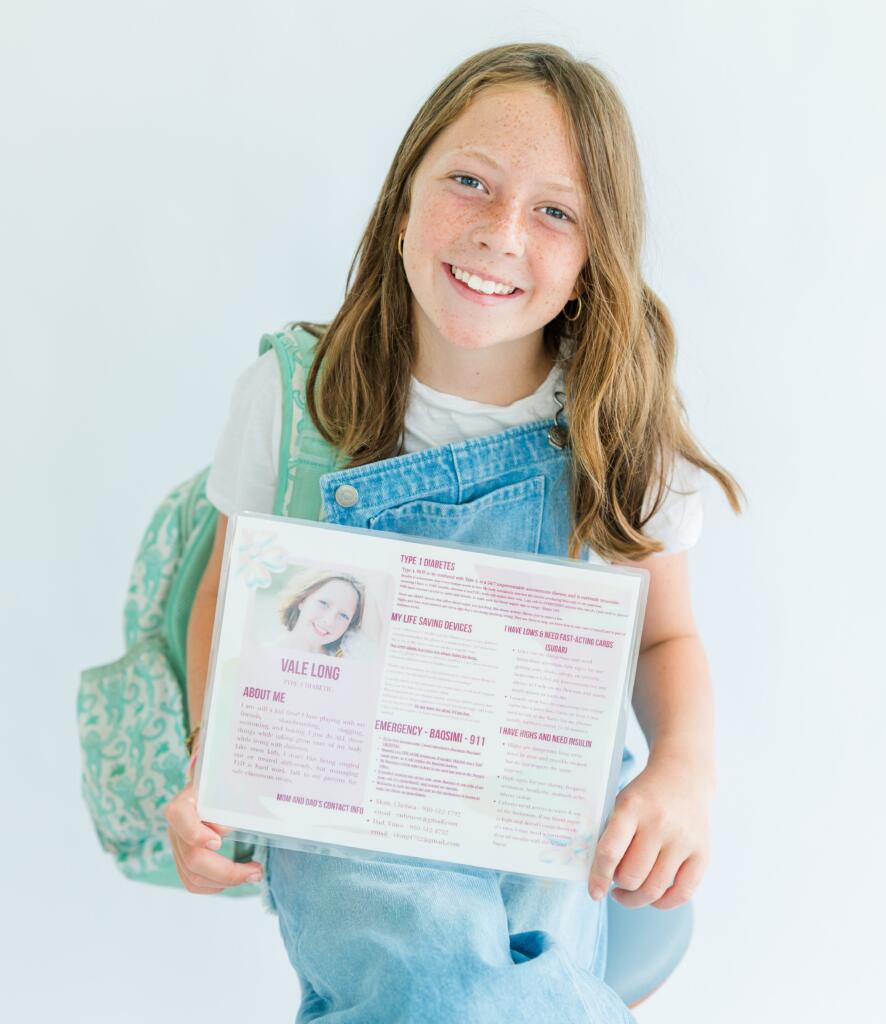
In addition to the 504 Plan, Chelsea created a document “essentially like a resume or CV” for Vale’s teachers, who also keep a copy in their classrooms in case there’s a substitute.
“It tells about her as a child, aside from diabetes, but also it’s kind of a quick cheat sheet for people that don’t know any type 1 diabetics,” Chelsea said. “It tells a little bit about like what her symptoms may be if she’s not able to share those when she’s high or when she’s low.”
Letting Kids Be Kids
After Vale was diagnosed, Chelsea had her other 4 children undergo genetic testing for T1D.
“Our 4-year-old came back positive with 3 of the antibodies, so she is currently stage 1,” Chelsea said.
That 4-year-old is currently in Pre-K at the same school system as Vale—Chelsea says teachers are looking out for T1D symptoms like frequent bathroom breaks. And Chelsea’s ready to apply what she’s learned over the past year with Vale once it’s necessary for her other daughter.
“I think it would definitely be smoother than what we have experienced,” Chelsea said. “Not that it’s been a bad experience—it’s just been a lot of a learning curve.”
Additionally, Chelsea says it’s important that Vale still gets to be a kid, despite her T1D diagnosis.
“When you’re a newly diagnosed child, you honestly go from being a child to having to take on a lot of responsibility, even though your parents are managing it for you,” Chelsea said.
“We have tried really, really hard and asked the school to be on board with us to let Vale be a child first, and help her manage that so she can be a kid, learn, and her distractions are very limited—it’s only more for the emergent situations that she needs some help there,” she added. “It’s really important to take a collaborative approach with the school, and voice your concerns if there’s something that you’re worried about.”
Community Connections
What would Chelsea say to other parents navigating a child’s T1D diagnosis? Give yourself grace.
“We do so much to try and prepare and then inevitably technology fails or, you know, a sensor falls out,” Chelsea said. “Kids are kids and especially Vale, she’s very rough—she plays hard, loves swimming, and is very active. We have rarely had a week at school without some device malfunction—it’s going to happen, but it’s going to be okay.”
“We can pack the bags and have everything we need, and then sometimes blood sugars are wonky and you just really have to roll with it,” she added.
And she recommends getting involved in your local T1D community.
“Find your people who will help you walk alongside this journey,” Chelsea said. “We also have a set of twins, just separately speaking, and it’s kind of like twins—you don’t know how many people have twins until you have them, and now I see them everywhere. It’s the same with diabetes. I knew two people in my whole live with type 1, and now I know more than I can count, even in this short time.”
Getting involved in Wilmington even led Chelsea to create an iPhone app (T1D Wilmington Warriors) with the help of her neighbor, which she shared with their local endocrinologist office as an asset for newly diagnosed families. They had a group text before, but Chelsea says a downside of that was people could only see messages dating back to the moment they were added.
“They can’t look back and say like, ‘Who is your favorite eye doctor?’ or ‘What do you do if?’ or ‘Do you have a recommendation at the beach?’” Chelsea said. “With this app, you can see everything. It’s kind of like a Facebook group, so to speak, but we post resources and events in the community.”
And she says that’s another great point for community.
“If something doesn’t exist, you can create it,” she said.
