Hy-Vee’s dedication to Breakthrough T1D’s mission is personal.
Type 1 diabetes (T1D) first struck the Hy-Vee family in 1921, when company co-founder Charles Hyde’s oldest son, Paul, died from the disease when he was 8 years old.
Since 1998, Hy-Vee has been a trusted partner of Breakthrough T1D, raising nearly $20 million through a variety of corporate and store events, including Walks in the Midwestern and Southern U.S. Hy-Vee also participates in Rides across the country; in 2025, they were recognized as a top fundraising team, bringing in over $230,000 for T1D research.
Hy-Vee’s 2025 in-store fundraising campaign for Breakthrough T1D runs from September 1 through 30. Find your local Hy-Vee here.
Working together for cures

Sam and Lauren Raiche are loyal Hy-Vee customers. They’re also dedicated fundraisers, advocates, and volunteers for Breakthrough T1D. Their 8-year-old son, Alexander, was diagnosed with T1D at age 3.
They appreciate Hy-Vee’s commitment to Breakthrough T1D’s mission. “It means so much to know that a company we already trust and shop with is also supporting a mission so close to our hearts,” Lauren said. “Living with type 1 diabetes is a daily challenge for our family, and seeing Hy-Vee stand behind research and programs that directly impact families like ours makes us feel grateful and supported every time we walk through their doors.”
Alexander represented Kansas at the 2025 Breakthrough T1D Children’s Congress. As a Delegate, he met with representatives to advocate for renewal of the Special Diabetes Program, which funds critical type 1 diabetes research. “Advocacy has become a cornerstone of our journey,” Lauren said. “We firmly believe that raising awareness and engaging with the community are essential steps toward making meaningful progress and, ultimately, achieving cures.”
Accelerating cell therapy breakthroughs
Support from partners like Hy-Vee helps fuel that progress toward cures for type 1 diabetes. Breakthrough T1D’s cures portfolio includes cell therapies, which replace destroyed beta cells with protected functional cells to restore insulin therapy independence and glucose control, ideally without immunosuppression.
Over the past decade, Breakthrough T1D has funded more than $156 million in cell therapies research, including partnerships with organizations like Vertex Pharmaceuticals and Sana Biotechnology.
In 2024, Vertex launched a pivotal clinical trial for zimislecel (formerly VX-880), which uses manufactured islets to restore the body’s ability to produce insulin. The therapy, however, requires the use of immunosuppression to protect the transplanted cells from rejection. The islets used in zimislecel are derived from the Breakthrough T1D-funded work of Doug Melton, Ph.D., who first turned precursor cells into insulin-producing cells in 2014.
A 2025 study from Sana Biotechnology showed that hypoimmune (HIP) donor-derived islets are making insulin and avoiding immune detection in the first person treated. The T1D Fund: A Breakthrough T1D Venture invested in Sana to help advance their HIP technology platform.
Breakthrough T1D continues to drive innovation to develop cell replacement therapies and eliminate the need for immunosuppression. With the generosity and support of partners like Hy-Vee and families like the Raiches, we will change the lives of everyone facing type 1 diabetes.
Breakthrough T1D is Wawa’s longest-standing partnership. Since 1994, the popular convenience store chain has raised millions of dollars for type 1 diabetes (T1D) research through in-store fundraising campaigns at more than 1,060 locations across the Eastern U.S.
Wawa’s partnership with Breakthrough T1D is further enhanced by donations from The Wawa Foundation, which is committed to helping Breakthrough T1D create a world without T1D and building strong communities by supporting causes related to health, hunger, and everyday heroes.
Wawa’s 2025 fundraising campaign for Breakthrough T1D runs from July 31 to August 20. Customers can donate $1, $3, or $5 or round up at checkout to support life-changing breakthroughs for people living with T1D.
Wawa lives out the values it speaks to
Wawa super fan, Nate Keeney, has lived with T1D for 27 years. He is proud to support a company that lives out the values it speaks to.
“Long before working at Breakthrough T1D, I loved Wawa for their larger selection of food options and snacks,” Nate said. “I always knew they partnered with the organization, but seeing how their efforts impact everyone living with T1D has given me a renewed passion to continue supporting Wawa.”
Wawa walks to cure T1D
Breakthrough T1D Walk is another way Wawa helps support the T1D community and fund critical T1D research. The Wawa Foundation matches employee Walk fundraising efforts up to $100.
Wawa associates also volunteer at Walk events to distribute in-kind food and beverages to participants.
“I see Wawa everywhere at our local Breakthrough T1D Walk in Philadelphia, with their classic soft pretzels and iced teas (and diet iced teas!) to fuel us as we walk to support T1D research and community,” Nate said. “The Goose also leads the T1D parade before the Walk begins.”
Wawa helps fuel life-changing research
Wawa helps Breakthrough T1D advance its mission to accelerate life-changing breakthroughs to cure, prevent, and treat type 1 diabetes and its complications.
That includes technology like continuous glucose monitors (CGMs) and automated insulin delivery (AID) systems, which have been life-changing for Nate.
“My insulin pump and CGM have been a wonderful addition to my diabetes routine—they’ve helped me get my A1c into a great range and identify trends,” he said. “Also, the ability to manage my T1D from my phone has made life on the go easier, whether it’s traveling for work or traveling for fun to different states or countries.”
Wawa’s support also fuels research in cures for type 1 diabetes. Cell therapies that insert healthy insulin-producing cells into people with T1D with minimal or no immunosuppression is a breakthrough Nate is hopeful for.
“So much effort, intensity, and care are going into funding research, particularly with cell therapies,” he said. “It makes me hopeful for cures within my lifetime.”
Together, Wawa and Breakthrough T1D are championing life-changing research and strengthening the T1D community.
Written by author and dedicated Breakthrough T1D supporter, advocate, and volunteer Moira McCarthy, pictured above with her daughter, Lauren
It’s now part of my morning routine, but not in the way most type 1 diabetes (T1D) parents would expect.
I grab my phone, open the continuous glucose monitor (CGM) app, and squeal with delight while wiping a strange salty substance from my eyes.
Because, just about every morning, I see something I thought would never be possible in my daughter’s 28 years of living with T1D: a perfectly straight line, totally in range.
It feels—and I not only don’t use this word lightly, but I’ve also never actually used it for a diabetes breakthrough before—transformational.
Starting a new T1D tool
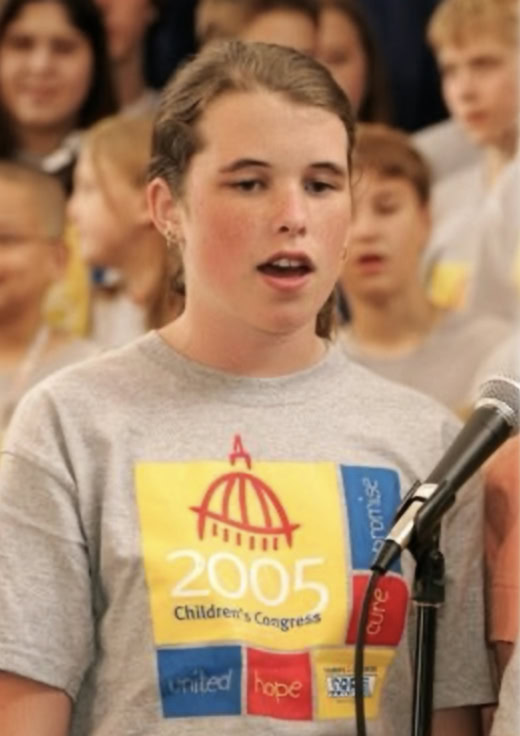
My daughter, Lauren, diagnosed with T1D at age 6 and now almost 34, was late to the game when it came to automated insulin delivery (AID) system adoption. But, about three months ago, she–as her amazing adult endocrinologist kept telling me she someday would when she was ready–decided to give it a try. She chose one of the new, snappy automated insulin delivery systems as her newest tool after a seven-year pump break using pens and a CGM.
She was nervous. She’d experienced some tough years of burnout in the past and had long connected that with using a pump. She was hopeful, but skeptical.
It took her about 24 hours to realize this was truly worth it. And it took me about as much time to feel saved. Saved!
And here’s the cool thing: As long-time JDF, then JDRF, and now Breakthrough T1D volunteers, we absolutely saved ourselves.
That’s because, raising our hands from nearly the start (we attended our first Walk a year after her diagnosis), we were able to not only dream of what could be, but also make it happen.
There’s power and beauty in that, at a level I didn’t anticipate. And that’s the story I want to share. How we, just an average American family impacted by T1D, were able to lead, push, advocate, and win our way to access to smart devices like automated insulin delivery systems. We helped create a solution.
I should preface this with a fact: I’ve never been one to worry about my daughter. I attribute that to having raised her before technology and before the internet. We learned to trust and know that sometimes things go awry, but we can fix them.
But all T1D parents worry. Me? I worried about way, way down the road. Would she be okay in her midlife and later? I wasn’t sure.
Fueling breakthroughs from the ground up
Nearly 20 years ago, I was at an International Board of Directors meeting when then member Jeffrey Brewer had what I call his “pound the shoe on the table” moment. He offered $1 million with the stipulation that we, as an organization and as people passionate about a cure, also focus on creating technology to help people live better with T1D.
I was all in.
As National Advocacy Chair at the time, I helped our organization find funding and people for the original CGM trials. (Did you know no one else would do it, so we just did it ourselves with such great success that industry jumped on board?) We also fought for coverage—we literally found a person in every major insurance plan and filled out paperwork to get the first person covered in each, setting the precedent and swinging the doors open for all (well, almost all; insurance is a work in progress).
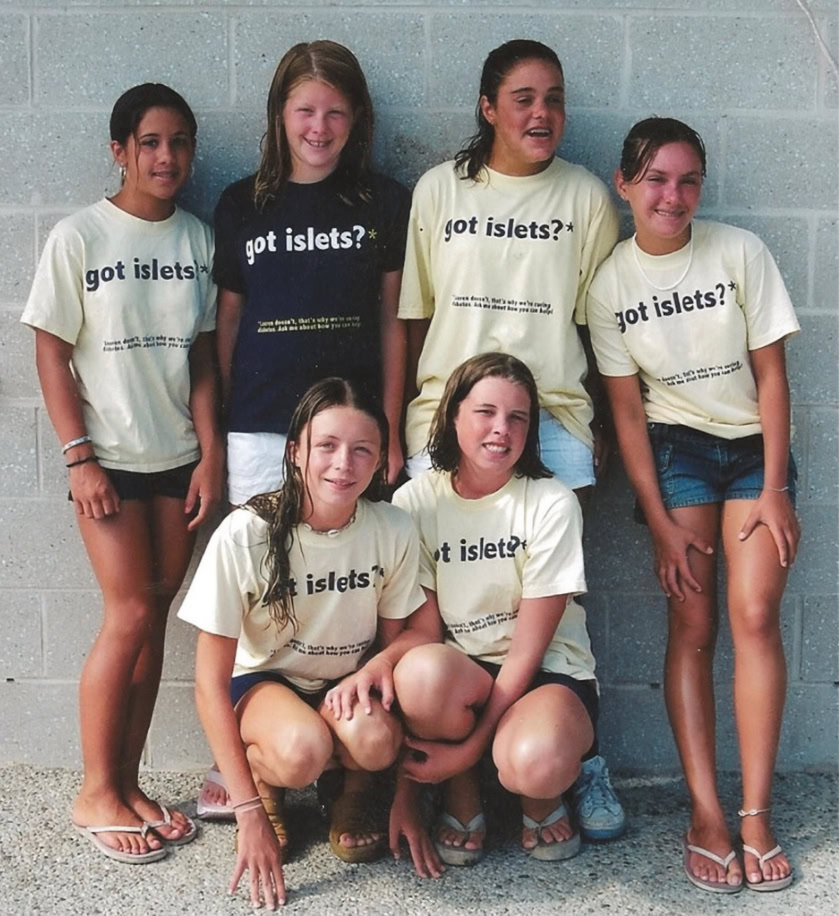
We did the Walks—our team, “Got Islets,” was one of the most successful in the nation. Then my daughter and I did the Rides, with our many friends continuing to donate after decades of us asking. Being directly involved gave me a voice in where funding went and how we focused our efforts. To me, tools that lessen the daily, hour-by-hour burden just made sense.
But, until a few months ago, it lived only in my imagination. While we’d always been early adopters (Lauren was the first young child in our state to go on a pump and one of the first in America to go on a CGM), as I said, it took time for her to be ready for this.
Little victories add up to big outcomes
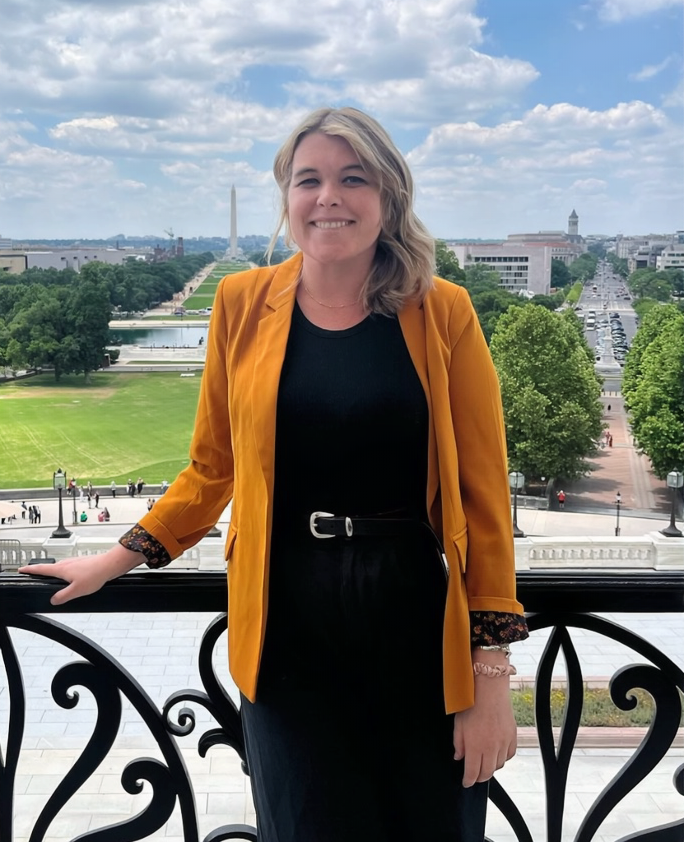
Friends, it’s not a fever dream. This is real, and it’s spectacular. My daughter’s A1c fell quickly to nearly non-diabetic range. Her other labs are, as her endocrinologist said, “those of a person without diabetes.”
But more than that: She feels great! “Mom,” she told me the other day, “this sleeping all night thing? It’s pretty great!”
She feels more focused and refreshed—and since she works in advocacy fighting for coverage and treatments for Duchenne Muscular Dystrophy, that matters.
A Soul Cycle and Pilates enthusiast, she’s finally solved her workout dilemma. Before the automated insulin delivery system, her pattern was this: work out hard, crash low, eat all the carbs on the planet, marinate in remorse. Now? Activity mode works like a charm for her. No more blood sugar crashes, and way more workout satisfaction. Post-workout, she marinates in the feeling of success. The little things are the big things.
Finding our voice for powerful change
When we talk about my daughter’s improvements (and they’re such a big deal, we talk about them a lot!), we always go back to how we helped make this happen.
Like any long, long-term relationship, the organization and I have had our ups and downs. But I realize this: Had I not stumbled upon that Walk in 1998 (thank you, Marshall’s employee, for asking me if I wanted to give a dollar to help cure diabetes. Look what you did!), we may not have found our power, our voices, and our ability to bring positive change. And that feeling of having been a part of bettering her life firsthand? It’s incredible. We found power in what felt like a powerless future.
By the way, that “we” is more than my family. Every time I bump into friends who are long-time donors to this cause, I click on my phone, show them her in-range chart, and cry as I tell them, “YOU did this for us. YOU made this happen. I promised you every time you donated, I’d never just let your money go into a black hole. Here’s the proof. You did this for my kid.”
And me? An average suburban mom, given what seemed on day 1 to be an unbearable burden? Rather than give in to that, Breakthrough T1D helped me rise from it.
If you see me around, ask me to show you the graph I looked at that morning. When that salty substance leaks down my cheeks, know those are tears of joy.
And of thanks. We did what every parent dreams of: me, my friends, and Breakthrough T1D changed my child’s life for the better. This mom is over the moon. I cannot wait to see what the next generation of T1D parents and people living with T1D make happen. Because it’s truly in our hands.
We are our own solution. And from this view, that feels pretty darn great.
Your story matters
Living with T1D looks different for everyone. We want to hear your story: the highs, the lows, the challenges you’ve overcome, and the people who have supported you on your journey.
When Charlie was diagnosed with type 1 diabetes (T1D) in February 2015, he was just 22 months old. His family had recently moved to a new state, far from the support network they once knew, and were navigating not only the complexities of a T1D diagnosis but also other serious medical challenges that required constant care and vigilance.
Charlie couldn’t walk independently, and his respiratory issues meant every day carried a little extra weight. Ashleigh, his mom, was a stay-at-home parent at the time, managing life with Charlie and his sister, Violet. The early years were isolating—a new town, a new diagnosis, a new reality. But in May of 2017, something changed.
Finding a community of support

Ashleigh came across a Walk organized by Breakthrough T1D (then JDRF) and signed up on a whim. She didn’t expect much. But when the day came, the support was overwhelming. That single act—joining the Walk—sparked something powerful. From that first event, Charlie’s Checkers was born.
Their extended family rallied around them, and a growing community formed. Since their first steps as a Walk team, Charlie’s Checkers has grown into a mission-driven force, fueled by love, resilience, and a fierce commitment to helping other families impacted by T1D.

Together, they’ve raised nearly $100,000 to help fund research to cure, prevent, and treat type 1 diabetes.
Charlie himself didn’t care much about the Walk—as long as he got to enjoy the ride around the lake in his wagon, he was content. He was a kid who took his time warming up to people, but once he did, he carved out a permanent place in their hearts. To know Charlie was to love him.
A legacy that lives on
In June of 2023, Charlie developed sepsis and was hospitalized for over three weeks. On July 1, 2023, he passed away from complications. He was ten years old.
Today, Charlie’s Checkers continues—no longer just walking in his honor, but in his memory. The mission remains the same: to support Breakthrough T1D’s work in driving awareness, education, and critical research. Through heartbreak and healing, Charlie’s legacy lives on in every step his team takes.
And they’re just getting started.
By Ashleigh Sand, Charlie’s mother
Walk toward cures
Breakthrough T1D Walk is the largest global event for the T1D community, driving research, advocacy, and support to improve lives while funding cures research.
Living a full and healthy life with type 1 diabetes (T1D) became clear to Matt Edgington when he was a teenager. He had been living with T1D since the age of 4, but his teenage years brought frustration and burnout. He didn’t check his blood sugar enough or administer the right amounts of insulin, resulting in a less-than-ideal A1C. “Coupling hormones with an attitude-filled teenager was just a recipe for disaster,” he said. “I wish I could say that was some kind of wake-up call, but it really wasn’t.”
Around that time, Matt started riding mountain bikes with his older brother and friends. That was the start of a major shift in his life. “As I started to ride more, everything just started to click: the better my blood sugar was, the better I was able to ride. The more I rode, the easier it was to control my blood sugar. It became a revolving door that had a huge impact on my life.”
Team Mattman
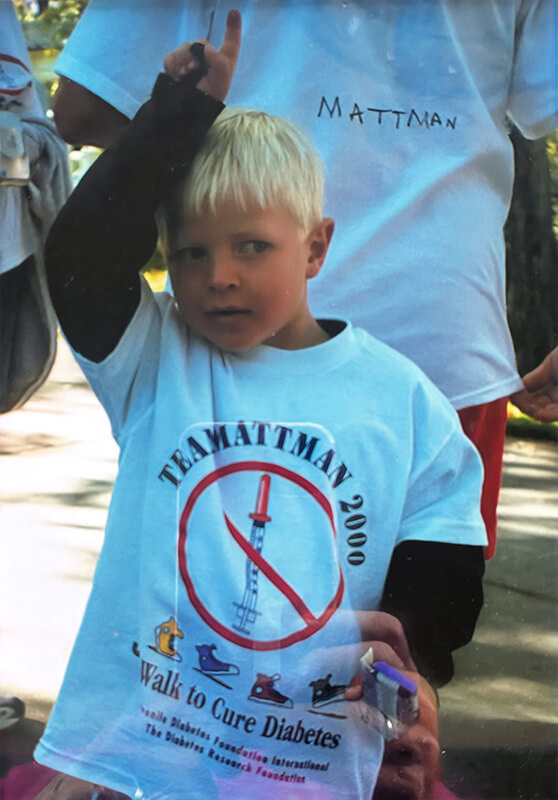
When Matt was diagnosed with type 1 diabetes, it didn’t entirely come as a surprise. His father, Ruedy, was diagnosed with T1D in 1970 at age 12 (and told by his doctor that he wouldn’t live to be 18!). “It was obviously horrible for them, but it wasn’t like this brand new, unknown thing,” Matt said. “My dad had been managing his T1D for 30 years at that point, and my mom was familiar with the day-to-day life of it.”
The Edgingtons immediately got involved with Breakthrough T1D (then JDRF), starting a Walk team, Team Mattman, in their Reno, NV, chapter that continued for the next 14 years. “That was, hands down, my favorite day of the year, every year,” Matt said. “I used to autograph everyone on my team’s shirt!”
Grabbing fundraising by the handlebars
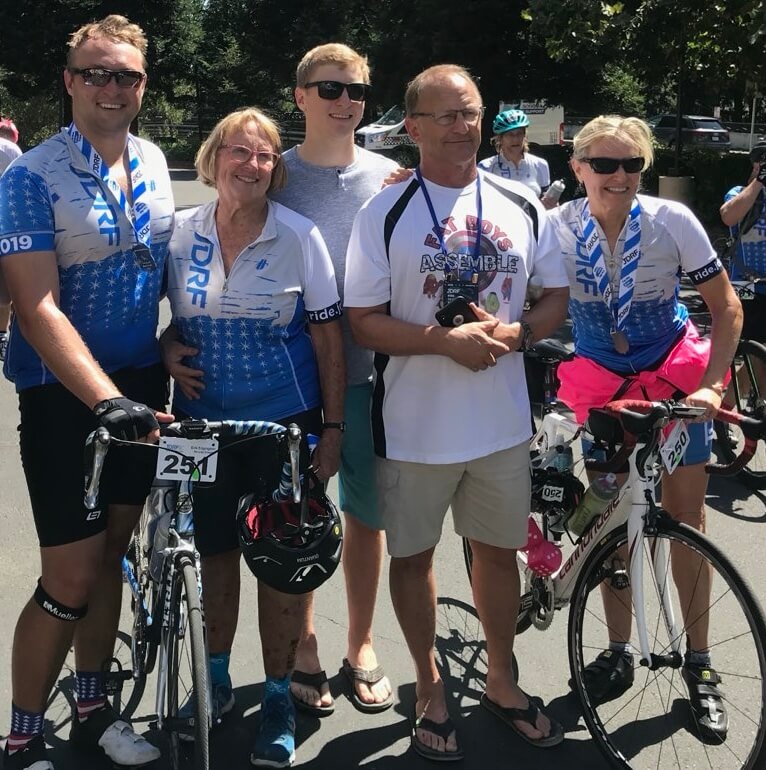
As Matt got older, the Edgington family started looking for new ways to support the T1D community. “We still had a desire to be involved and continue to raise money, so, as a cycling family, our efforts naturally rolled over right into doing Rides,” Matt said.
Breakthrough T1D Ride also felt like something he could stamp as his own way to raise money and awareness for type 1 diabetes after his family had led efforts for so many years. “Riding at the front with the fast riders, and now being a Ride coach, feels like the first contribution that I am making on my own to the organization,” he said.
Ride coaching was a natural evolution for Matt, who now lives in Utah. “It’s the most outdoorsy community I have ever been around, so it felt like a huge opportunity to grow the Ride program here,” he said.
To date, Matt’s parents have done more than 25 Rides. This year will mark Matt’s 15th Ride.
Confidence through cycling
Cycling has given Matt confidence he never imagined. He recently completed a 100-mile mountain bike race in Leadville, CO, and considers that his biggest T1D success. “Training and completing that ride was a huge statement that a person living with type 1 diabetes can do anything.”
But to Matt, now more than 25 years into his T1D journey, there is still no cycling event quite like the Breakthrough T1D Ride. “It’s an inspiration: the people with T1D all on their bikes fighting for the same cause.”
Your story matters
Living with T1D looks different for everyone. We want to hear your story: the highs, the lows, the challenges you’ve overcome, and the people who have supported you on your journey.
Written by David Corsaro, Matthew’s father
Why do we walk? We walk because of a memory.
We may never lose the memory of sitting in a hospital room when the doctor told us that our 15-month-old son Matthew, a baby with his entire life in front of him full of open possibilities, had type 1 diabetes (T1D). We were told he would spend the rest of his life monitoring his blood sugar, receiving insulin, and being very aware of things that many of us never have to think about, like his glucose level and beta cells in his pancreas.
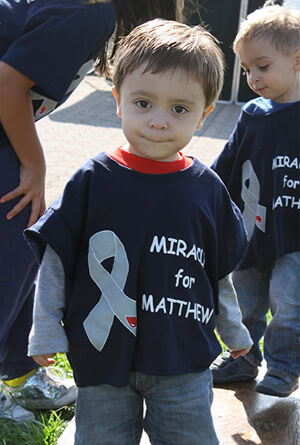
When we were connected with Breakthrough T1D, it was an awakening. We met people going through the same roller coaster of emotions that we were. We met people who told us, “We understand,” in a way that our family and friends could not.
The road also travels both ways. We have been fortunate enough to speak to the parents of newly diagnosed children and look into their eyes. We have been able to provide a comforting word or hug to someone who felt the same way we did after diagnosis.
Within one month of Matthew’s diagnosis, we signed up for the Breakthrough T1D Walk. Instead of feeling helpless because there is no cure, we looked at it as discovering a new cause that we had to fight for. It was something that was within our control to help make his life better.
So why do we walk with Breakthrough T1D? Because of a memory.
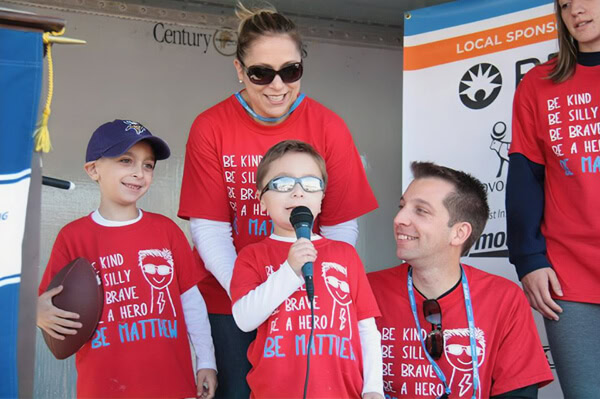
A memory of Matthew standing on stage at the Breakthrough T1D Walk, watching him take the microphone to start the event countdown.
But most of all, we walk because of the memory of Matthew saying, “I wish I did not have diabetes,” and knowing that the research funded by Breakthrough T1D will improve his way of life and take us a step closer to his wish of finding cures.
Walk toward cures
Breakthrough T1D Walk is the largest global event for the T1D community, driving research, advocacy, and support to improve lives while funding cures research.
Outside the Cammett family’s Michigan home sat a new toy truck. John, around six years old, admired its sturdy metal frame, fresh rubber wheels, and bright yellow decals. But it would not stay that way for long.
John and his two brothers were athletic, boisterous, and yes, at times, destructive. After the truck was thoroughly battered, John’s mother, Barbara, began her work on the piece. She was creative and artistic and knew just what to do. With paint brushes in hand, she covered the damaged truck in a collage of color and something new emerged. It was no longer a wreck, it was a work of art.
John Cammett, now 62, says he’ll always remember that day and the special lesson that came from it.
“Even with all that destruction, she could make something look beautiful,” he said.
Like mother, like son
John’s mom was diagnosed with type 1 diabetes (T1D) in her 30s and passed away in 2021 at age 89. She inspired John, who also lives with T1D, to become a champion for others with the condition. John has since become a longtime volunteer, leader, and advocate for Breakthrough T1D—providing transformational support of our mission.
In recognition of his deep commitment, the Breakthrough T1D Center of Excellence in New England was recently named for his mother. The center will now be known as the Breakthrough T1D Barbara Dewey Cammett Center of Excellence in New England. John helped establish the center and provided foundational support for Project ACT (Accelerate Cell Therapies), Breakthrough T1D’s initiative to make cell therapies as cures for T1D a reality.

My mom was the strongest person I’ve ever known—a real warrior. Even back then, with limited technology, she never let T1D set her back.”
Honoring her positive spirit
Since its inception, the Breakthrough T1D Barbara Dewey Cammett Center of Excellence in New England has made significant progress advancing islet cell-based T1D research, enhancing the understanding of the immune response following islet transplantation to prevent rejection, and creating genetically modified islet cells that could withstand the immune attack after transplantation into people living with T1D.
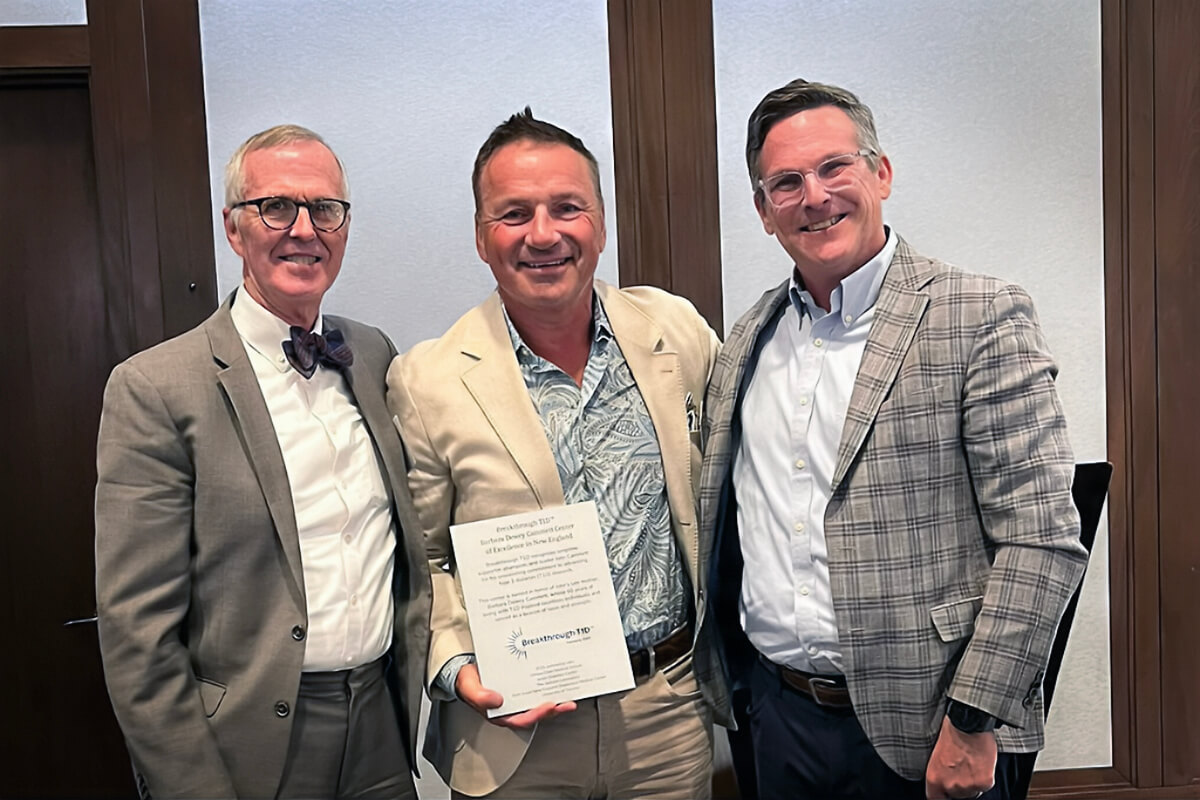
The breakthrough research happening at the center—one of five Breakthrough T1D Centers of Excellence around the world powering advances to deliver cures and life-improving breakthroughs for T1D—is particularly inspiring to John. He takes pride in knowing that the center he helped establish will not only advance this important work but also honor his mother’s positive spirit and enduring legacy.
“You can’t be a researcher without optimism—every breakthrough stands on the back of countless failures. My mom lived the same way. She was the most optimistic person I’ve ever known, never said a bad word about anyone, and kept going no matter how hard things got. Just like the researchers pushing forward every day, she stayed focused, kind, and hopeful through it all.”
A beacon of strength
John remembers his mom as a woman whose generous heart, zest for life, and unwavering optimism inspired everyone she met.
She managed T1D for nearly 60 years with grace, determination, and a smile. Known for her vibrant personality, Barbara embraced life fully. You could often find her cheering on her Wisconsin Badgers, painting beautiful art, volunteering in her community, and effortlessly outdriving her husband on the golf course.
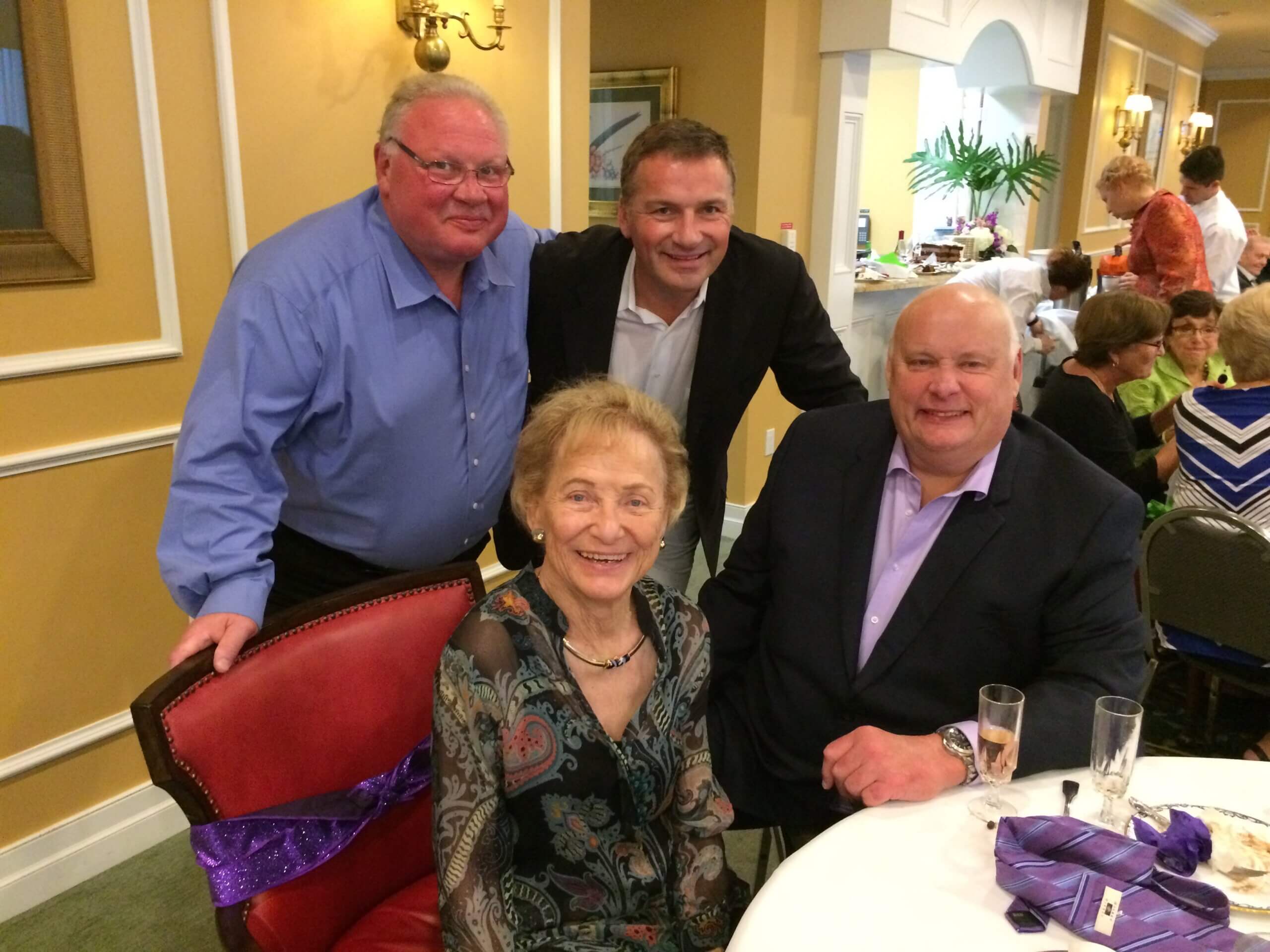
Her kindness, resilience, and passion for connecting with others made her a beloved friend, devoted wife, and beacon of strength to those navigating life with T1D.
“I wish I could have done this while she was still with me,” John said. “But I know she’d look back and smile. She wanted to help everyone she could. That spirit lives on.”
By: Adam Baker
Guest article by Sam Glassenberg, a video game developer who has created games for major Hollywood films like Star Wars, the Hunger Games, and Mission Impossible.
Worst. Game. Ever.
In December 2019, our 5-year-old daughter, J, was diagnosed with type 1 diabetes (T1D). The onboarding experience was absolutely brutal.
When making games, there are all sorts of rules and design principles to make them easy to learn, fun, and highly rewarding—that’s why the video games industry is now bigger than Hollywood and the music industries combined.
As a game developer, it was shocking to see how the onboarding and ongoing management of type 1 diabetes literally turned every video game design best practice on its head. To experience type 1 diabetes is to experience something that takes all of the best practices involved in creating a wonderful, engaging, rewarding game, and inverts them to create the most frustrating and punishing experience possible for the patient and caregiver alike.
I’m a computer engineer. My wife is a primary-care pediatrician. On paper, we’re the T1D management dream team. It didn’t matter. We read all the books, and it still took us a year of gut-wrenching trial-and-error on our own child to finally understand how this all works: carb ratios, insulin sensitivity factor (ISF), pre-bolusing, digestion rates, and insulin stacking.
Learning through play
Humans (all mammals, actually) learn best through play. That’s why video games are so effective at helping humans develop mental models of complex systems – from predicting parabolic flight (Angry Birds) to understanding how cities work (Sim City).
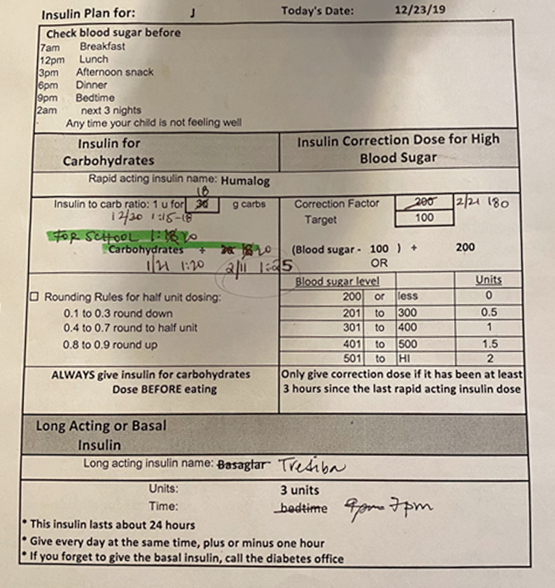
I still remember the one-page guide we received after those two first days in the hospital: a page of hand-scribbled carb ratios, insulin sensitivity factors, and instructions from the endocrine department that made little sense.
How it should be
Imagine it’s day #2 in the hospital. Mom and Dad are beside themselves as the magnitude of their new responsibilities as a full-time pancreas becomes brutally clear. The diabetes educator walks in.
“Here, download this game. Play it for two hours. It’ll explain all of this. Come to me afterward with any questions”.
I would have played the crap out of that game had it existed.
Joining the team
Shortly after J’s diagnosis, I joined the Breakthrough T1D Play advisory council (JDRF Game2Give at the time). It turns out that there’s a whole team of veteran game developers and executives like me who have T1D or care for someone who does. Play does amazing work, from creating a virtual world experience on Roblox to fundraising for Breakthrough T1D on Steam, Twitch, Humble Bundle, and other game platforms.
Everyone was on board with the idea of using games not only to fundraise for type 1 diabetes, but to improve the T1D onboarding process for the newly diagnosed.
Choosing the right mechanic
About a year into the process, I had developed a solid ‘mental model’ about what was going on inside my daughter’s endocrine system. How could I share that mental model? What video game mechanics are best for helping someone understand T1D?
A few popular reference games came to mind:
- Rhythm games like Guitar Hero and Rock Band are great at training your brain how to time your actions with a simple interface – like timing insulin dosing.
- Games like Missile Defense encourage you to shift your thinking from where the target is to where the target is going – just like with glucose curves.
- Particle Puzzles like Frost and Where’s My Water use swarms of particles to captivate and inspire the player
So, I got to work writing up a Game Design Document (GDD).
A Level Ex game jam
As it happens, my current company, Level Ex, makes video games for doctors. Roughly once a year, we host a “game jam,” where we break out into teams, and each team has ~48 hours to produce a fully functional game prototype for a new idea. We used this game jam to prototype the game I’d designed and prove that particle mechanics really could capture the nuances of insulin and glucose dynamics (spoiler alert: it worked better than anyone expected).
Making the game: Level One
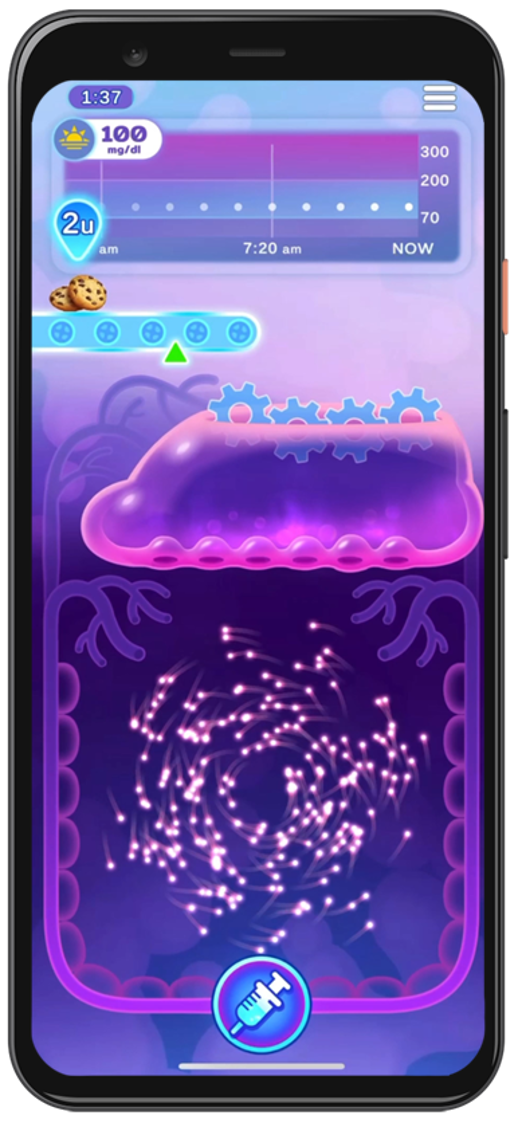
Once the prototype was working, we got to work on making the full game, honing the visual style, particle dynamics, and level design. Throughout the process, we play-tested it with endocrinologists, diabetes educators, parents, and camp counselors.
The results were overwhelming. Testers LOVED the game. Several times, we had to cut people off from the Testflight beta build because they were sharing the game with their patients when they weren’t supposed to.
Now available
After years in development, Level One is now available to download. We look forward to continuing to add features and improve the game as we go. Most importantly, the game is free to everyone (thanks to partners like Breakthrough T1D Play). We’re improving diabetes onboarding with a game that is actually fun to play, so no other parent has to go through this experience again.
Download Level One now:


The Breakthrough T1D Real Estate Games is an annual event sponsored by the Washington, D.C.-area commercial real estate community to benefit type 1 diabetes (T1D) research. Founded in 1990 by Adam Singer, Vice Chairman of longtime Breakthrough T1D partner Savills, Inc., the Games have evolved into one of the real estate industry’s top events of the year.
A dynamic volunteer partner
Adam Singer was diagnosed with T1D in 1978 at the age of 18 and became involved with Breakthrough T1D’s chapter in Philadelphia shortly thereafter. While a student at The University of Pennsylvania, Adam started T1D support groups in more than 30 cities. He was a member of Breakthrough T1D’s International Board of Directors (IBOD) from 1982 to 1985, the youngest in Breakthrough T1D’s history. Adam is a long-time advocate, gala honoree, and former board chair for Breakthrough T1D’s Mid-Atlantic Chapter. He currently serves as a Director Emeritus of the IBOD.
Cultivating relationships to advance our mission

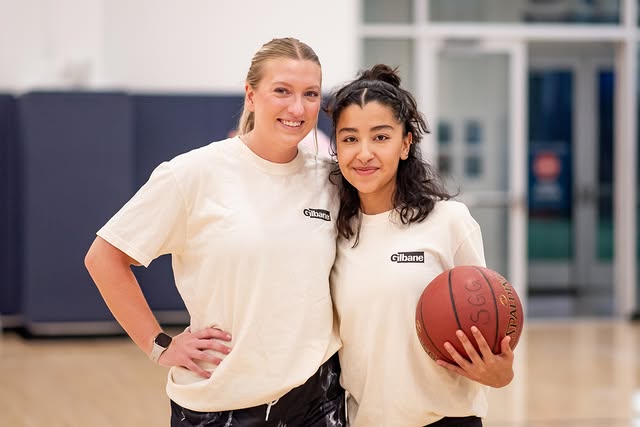

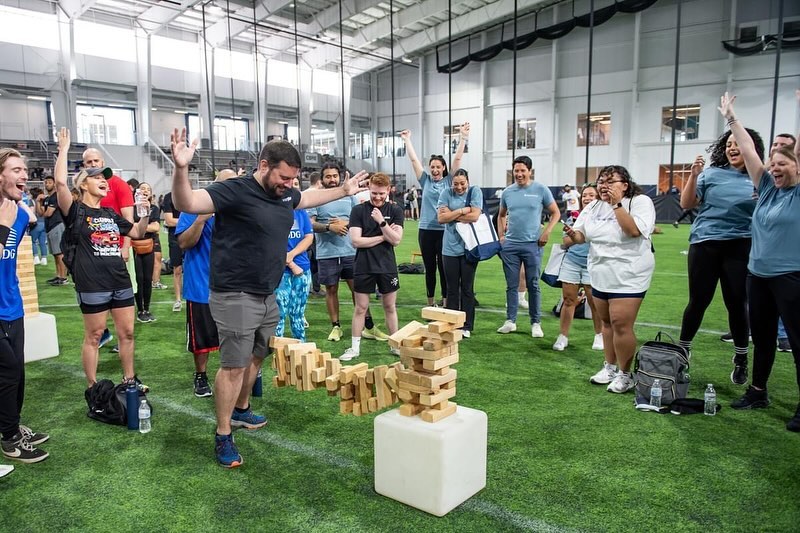
One of Adam’s most significant contributions to our mission is founding the Breakthrough T1D Real Estate Games. This annual day of Olympic-style competitions features real estate company teams competing against each other in “friendly” tournaments of 3-on-3 basketball, volleyball, tug-of-war, and more. Adam’s legacy continues to grow as Breakthrough T1D expanded the Games to New York City, Chicago, and, in 2025, Atlanta.
Over the past 30 years, the Games have raised more than $15 million for T1D research. This novel event showcases Adam’s ability to develop relationships, connect people to Breakthrough T1D’s mission, and drive fundraising.
Leadership in innovation
In 2023, Adam received the Breakthrough T1D John Brady Award for Innovation, which recognizes an outstanding volunteer who has exhibited leadership in driving innovation and pioneering projects with the potential to meaningfully impact the T1D community.
“Adam is a true type 1 diabetes champion,” said Aaron J. Kowalski, Ph.D., Breakthrough T1D CEO. “His innovative thinking and engagement of the commercial real estate community have created a longstanding tradition that has not only raised significant funds for life-changing research, but also demonstrated the power of volunteer leaders in moving us toward cures.”
Learn more about the 2025 Breakthrough T1D Real Estate Games:
Pictured above: Pat McFeeley (number 407) with fellow Rider Teresa Switzer at the 2024 Breakthrough T1D Ride in Coeur d’Alene, Idaho
You’d be hard-pressed to find someone more dedicated to Breakthrough T1D’s mission than Pat McFeeley.
After his twin daughters were diagnosed with type 1 diabetes (T1D) over 26 years ago at ages 1 ½ and 2 ½, Pat and his wife went all-in on fundraising and awareness-building. Since then, he has seen the direct impact of his efforts.
“The changes have been enormous since my daughters were diagnosed,” he said. “The disease has become far more manageable—it allows them to think about everyday life instead of always thinking about their blood sugar.”
But T1D is still something to manage. And Pat is doing everything he can to change that.
A volunteer and fundraising superstar
Pat has served in a tremendous number of volunteer roles at Breakthrough T1D over the years, including Ride champion, Speaker’s Bureau member, Gala honoree, Gala chair, chapter board member, chapter board president, International Board of Directors member, chancellor, Ride coach, and Walk team captain.
And his dedication doesn’t stop at volunteering.
Pat hosts an annual fundraiser in his backyard that draws hundreds of new supporters each year. He fills multiple tables at his chapter’s Gala every year and has raised millions of dollars through sponsorships and Fund a Cure. His Walk team, the McFeeley Marchers, would often raise over $100,000 in a single year.
He accomplishes this all by aiming high and seeing the ripple effect one dedicated person can create.
“I do a lot of speaking for Breakthrough T1D around the country,” he said. “One of the things that I tell all of my audiences is ‘think big.’ An individual can have an enormous impact.”
Ride: The spirit of the T1D community
For Pat, the spirit and camaraderie at Breakthrough T1D Ride is second to none. “The mission is front and center the whole weekend,” he said. “It’s clear that when we all get on our bikes, it’s to find a cure for type 1 diabetes.”
Recently, Breakthrough T1D’s North Carolina chapter wanted to grow its Ride program participation. Pat answered the call. He led a recruitment campaign in which he donated $250 to every new rider, returning rider, or rider who upgraded their fundraising package.
He also recruited George Hincapie, the most well-known American cyclist and 17-time Tour de France participant, to participate in the 2023 Breakthrough T1D Ride in Amelia Island. His efforts not only increased awareness of the Ride program but also resulted in more participants and more money raised.
Pat will continue to harness the energy of Breakthrough T1D Ride to support our mission of improving the lives of people with T1D until we find cures.
“To me, Ride is a great example of bringing together relationships and experiences and making a difference in the world for people living with T1D all at once,” he said. “I think those are some of the most important things in life.”
Breakthrough T1D 2025 Ride registration is now open!
Register to join us at the Breakthrough T1D Coeur d’Alene Ride September 25-28.
