
Hello from Philadelphia, PA! We could not be more thrilled that, after years and years, we have finally kicked off our inaugural Breakthrough T1D Clinical & Research Congress (CRC). This groundbreaking event is focused entirely on type 1 diabetes (T1D), and it’s happening right now!
Breakthrough T1D’s Clinical & Research Congress
The inaugural Breakthrough T1D Clinical & Research Congress (CRC 2026) is a groundbreaking forum uniting clinicians, researchers, scientists, healthcare professionals, industry leaders, and the T1D community. Attendees will explore cutting-edge advances in T1D science, clinical care, and more. Designed to foster collaboration and spark innovation, CRC 2026 will provide translational insights, interactive learning, and meaningful dialogue, all with one shared goal: improving lives and driving toward a world without T1D.
For the next three days, we’ll provide you with everything you need to know about this conference, the top takeaways, and what the path forward looks like so that people with T1D can live better, healthier lives. And in case you missed it, check out our precap on what we plan to cover.
Islet Cell Therapies: Research Supported by Breakthrough T1D or the T1D Fund
Piotr Witkowski, M.D., Ph.D. (University of Chicago) presented on the Breakthrough T1D-funded clinical trial for tegoprubart, an alternative to standard immunosuppressants, developed by T1D Fund company Eledon. Tegoprubart is maintaining its success: all 12 participants who have received an islet cell transplant are off external insulin (7 after one transplant; 5 after two) with stable blood-sugar levels, no side effects, and no toxicity in the kidneys. An upcoming clinical trial will test tegoprubart in people with T1D and chronic kidney disease (CKD)—the first time this population is eligible for an islet cell therapy.
Per-Ola Carlsson, M.D., Ph.D. (Uppsala University) provided an update on the first person treated with a partial dose of immune-evasive islet cells developed by Sana, another T1D Fund company. There were no serious side effects, and the cells continue to survive and make insulin over a year post-transplant.
Leonardo Velazco-Cruz, Ph.D. (Century Therapeutics, a T1D Fund company) presented on a manufactured immune-evasive islet cell therapy that has shown promise in animal models of T1D, advancing towards first-in-human studies and clinical-grade, scalable manufacturing. Unlike other therapies currently in clinical trials, Century’s product is both scalable and does not require immunosuppression.
Key Takeaway
We’re seeing continued progress in islet cell therapies, both in clinical trials and in preclinical development—bringing us closer to scalable solutions in which no immunosuppressants are needed.
Disease-Modifying Therapies
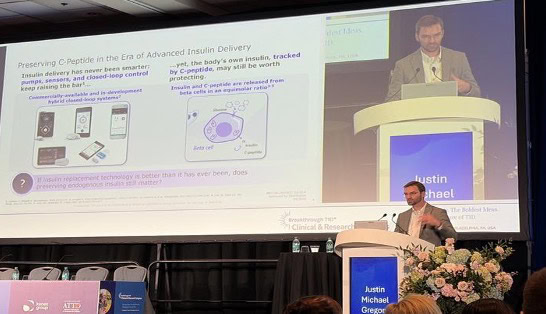
C-peptide
C-peptide is a biomarker of the body’s insulin production, which can be measured easily by a blood test. It’s formed when pro-insulin is cleaved into active insulin and C-peptide.
C-peptide: Why it Matters for Clinical Outcomes
- Presenter: Justin Gregory, M.D. (Sanofi)
- Based on several datasets, we know that more C-peptide means better glycemic control and fewer short- and long-term complications (especially severe hypoglycemia, diabetic ketoacidosis, and retinopathy).
- This relationship is foundational to why we are so focused on C-peptide: it matters!
- For years, Breakthrough T1D has advocated for the use of C-peptide as a validated surrogate endpoint, which would make DMT clinical trials smaller, faster, and less expensive—without cutting corners on safety.
Disease-Modifying Therapies Highlight: Work Supported by the T1D Fund
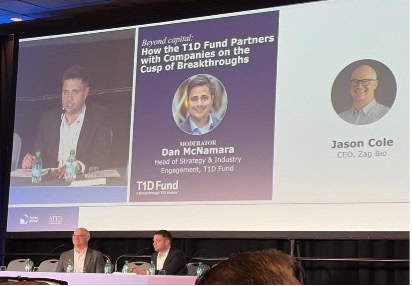
Dan McNamara, Head of Strategy and Engagement at the T1D Fund, sat down with Jason Cole, J.D., CEO of Zag Bio, a T1D Fund portfolio company focused on restoring balance to the immune system. They spoke about how expertise and funding provided by the T1D Fund can lay the groundwork for strategic partnerships that advance early-stage therapies for T1D.
Key Takeaways
- There is a positive relationship between C-peptide preservation and improved glycemic outcomes.
- T1D Fund investments in early-stage companies can accelerate DMTs (and other therapies and technologies for T1D) through capital, expertise, and support.
Early Detection
The benefits of screening for T1D are well established. Combined with follow-up and monitoring, early detection can reduce the risk of diabetic ketoacidosis (DKA) at diagnosis, connect people to clinical trials and specialists, open the door to FDA-approved therapies that can delay the need for insulin, and give families time to plan and prepare.
The question now is how to increase access to screening, and how to ensure people with early-stage T1D are connected to next steps and options. That was the focus of a panel chaired by Chantal Mathieu, M.D., Ph.D. (KU Leuven, Belgium).
Key Takeaways
- The case for early detection is settled. The work now is expanding access and making screening and monitoring easier for the people who take part.
- Less painful and more convenient testing, including at home or in community settings like schools, can help more people get tested and stay engaged.
- Support should fit the family, especially if there is a family history, and should include clear communication, psychological support, and continuity of care.
- Results must be backed up by clear, consistent communication.
Improving Lives
Kerendia (Finerenone): First New Therapy in 30 Years for Kidney Disease and T1D
- Presenter: Sergio Chang Figueroa, M.D. (University of Louisville), speaking on behalf of Bayer
- The FDA recently approved finerenone (brand name Kerendia), a once-daily pill already approved for type 2 diabetes, for people with T1D and CKD—the first advance in nearly 30 years for this population.
- CKD is one of the most common complications of T1D: nearly a third of people with T1D will develop it, increasing their risk of kidney failure and heart complications.
- As part of our Improving Lives program, Breakthrough T1D strategically collaborated with Bayer to support the FINE-ONE clinical trial that led to this approval.
Making Sure Your Insulin is Still Potent
- Presenter: Maren Schinz, Ph.D. (Beyond Diagnostics AG)
- People living with T1D may wonder if their insulin is still good to use after temperature changes—and this company is developing a way to fix that.
- Studies in animal models of T1D have shown that injecting insulin that has lost some of its potency doesn’t lower blood-sugar levels as well.
- This team developed an assay that can be paired with a smartphone to check the potency of insulin in real-time.
Automated Insulin Delivery (AID) in the Era of Artificial Intelligence (AI)
- Tadej Battelino, M.D., Ph.D. (University Medical Center Ljubljana) talked through use of AI in continuous glucose monitor (CGM) data, MRIs, and other clinical metrics to predict progression or monitor the impacts of T1D.
- Todd Brusko, Ph.D. (University of Florida) highlighted complex data types generated from human samples that can be analyzed with AI to help us learn even more about what causes T1D.
- Juan Espinoza, M.D. (Northwestern University) highlighted how to best integrate AI into T1D care in clinical settings.
- Boris Kovatchev, Ph.D. (University of Virginia) presented about how digital twins—a computational model for blood-sugar changes—fueled by AI can speed clinical development of next-generation AID systems.
Improving Lives Highlight: Research Supported by Breakthrough T1D
Marcela Moscoso, Ph.D. (University of Virginia), presented a tool that tracks insulin sensitivity and estimates blood-sugar changes after meals—a step toward fully closed-loop automated insulin delivery (AID) systems that wouldn’t require meal announcements. Tested through simulations and real-world clinical trial data, the tool successfully detected expected increases in insulin sensitivity during exercise and distinguished between fast- and slow-digesting meals, laying groundwork for smarter, more automated insulin dosing in the future.
Key Takeaways
- Finerenone’s recent approval remains in the spotlight as a major advance for people with CKD and T1D.
- New predictive models and algorithms are advancing toward fully closed-loop AID systems for people with T1D, meaning one step closer to no meal announcements.
- New technology will one day give people with T1D the option to check that their insulin is still 100% potent in real-time.
Medical Affairs
As early detection, disease-modifying therapies, and islet cell therapies move forward and treatment options expand, Tandy Aye, M.D. (Stanford School of Medicine), Brynn Marks, M.D. (Senior Director of Medical Affairs at Breakthrough T1D), and Katelyn O’Brien, Pharm.D. (Boston Medical Center) participated in a session chaired by Boby Gabbay, M.D., Ph.D. (Joslin Diabetes Center) about how the medical community needs to effectively adapt to the current and future state of T1D care.
Some high-level takeaways:
- The field is moving faster than the care system. The world of T1D is rapidly changing. The paradigm is changing, including the proliferation of screening and early detection and novel disease-modifying therapies and islet cell therapies. Clinical teams must be ready to keep pace with the current and future landscape.
- Islet cell therapies are coming—and they depend on workforce as much as science. There are severe limits to the supply of deceased donor islets (for now!) but there also aren’t enough care teams to administer them. Learn more about how we’re trying to solve this problem through Centers of Reference and Breakthrough T1D’s Interventional Diabetology program.
- Diabetes care and education specialists are an underused bridge. Fewer than 5% of Medicare beneficiaries and fewer than 7% of privately insured people get education in the first year after diagnosis. These specialists have longer visits, can close technology gaps (CGM, automated insulin delivery), and relay real-world challenges back to clinicians.
- The workforce pipeline is a concern. We need more endocrinologists.
Kick-off
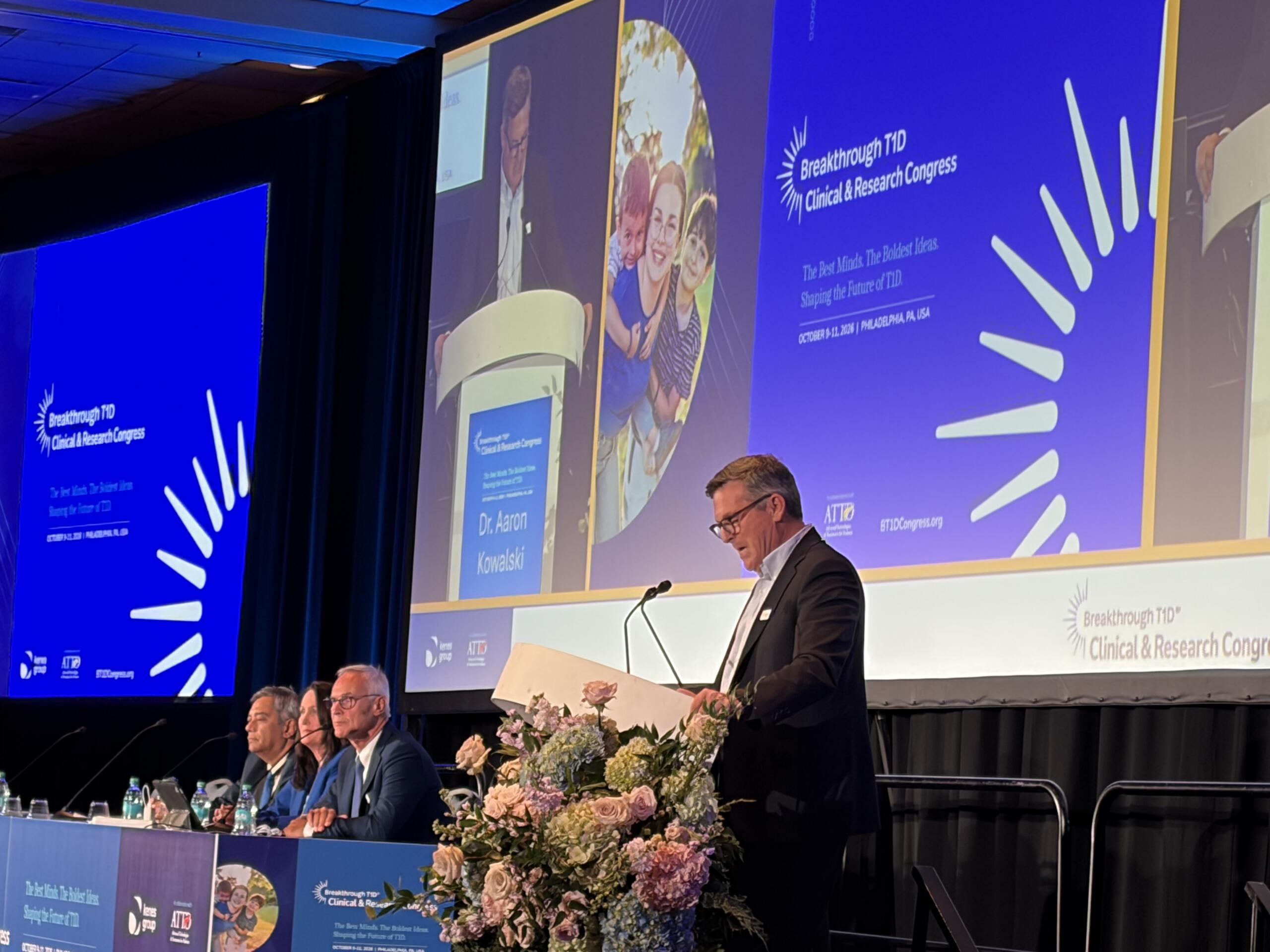
Dr. Mathieu closed the Congress’s opening day by describing the future of T1D as “two paths.” One is technology, and one is disease-modifying therapies plus islet cell therapies. These are not two disparate paths—technology has the capability to keep people healthy so that when they DMTs and islet cell therapies arrive at scale, people with T1D can make the most of it.
Where we are
- Technology works in the real world. Dr. Mathieu presented data from her homeland of Belgium showing HbA1c falling year over year, first with sensors (around 2017) and further with hybrid closed-loop systems. In addition to glycemic improvements, people with T1D are seeing lower risk of complications, including retinopathy and kidney disease.
- Disease-modifying therapies are here. Teplizumab, approved in November 2022, is the first therapy to delay the immune attack on beta cells. It has since expanded to children as young as one and to many countries.
- Screening is rapidly ramping up. Dr. Mathieu’s European consortium has screened about 140,000 children—and this is only increasing in Europe and across the world.
Our vision for the future
- Treat earlier in stages 1 and 2, to delay insulin therapy dependence by months, years, or decades.
- Personalize treatment using immune biomarkers that predict who will respond.
- Run more trials and build more integrated networks, like TrialNet.
- Islet cell therapies are next.
The last thing she said, and a key theme of this meeting, is the need for collaboration. We all need to set our egos aside and work together. The people in this room are responsible for the current state—and the myriad revolutions that have directly led to people with T1D doing better today. The people in the room are going to be the ones that make cures possible—but only if we work together.
Look out for articles coming soon covering days 2 and 3 of CRC 2026. Keep an eye on our News & Updates webpage!
